By Geo Kaan
It's a term that big social media companies use to get out of lawsuits. To cover their asses. And it's a term that just stops there. How could something be addictive that's just "problematic," right?
That's why when I wrote SoMed911 (Kaan, 2025), I deconstructed the term. If we're not using the word addiction, then what exactly is problematic about it?
On the social media elements and effects chart there are 40 problems packed into that one term. A spectrum of psychological problems that tie into each other, connect in unique ways for each individual depending on what they're being exposed to, and their vulnerabilities (see Understanding Socal Media Vulnerabilities).
Problematic, Addiction or Vulnerability: Is It Just a Defective Product?
There are hundreds, if not thousands, of studies on the effects of the screen, the interface, and how it manipulates and influences people. If you just focused on the memory loss studies, the changes in people's brains happen from prolonged social media use. Now notice I didn't say problematic social media use. I said prolonged social media use. And there's an after to prolonged memory loss as well, cognitive distortions. It's an effect where ability and perception takes a nose dive. This harm-spectrum is best seen on the chart following Memory element on track 3. See how on the Ne - Neural Entrainment track 2, Ch - Chronostasis or time distortion lives above Sc - Scotoma or memory loss. This element track, based on separate studies on visual/nervous system entrainment from screens line up. Time distortion lines up with memory loss.
Prolonged now shifts into a by-design mechanism of concurrent impairment across multiple domains. The 3 other element tracks you see in the chart also each have their own escalating effects. Object Attachment, Neural Entrainment, Memory, Attention, Instant Feedback; all tracks running a predictable slide. They don't stay isolated either. They cross, compound, and converge into is what I call the Redzone: compounded self-neglect where multiple systems fail simultaneously. It's a design output of prolonged use — as opposed to problematic.
TL;DR : On each element row, prolonged use runs a harm-sequence. The word "prolonged" does all the work.
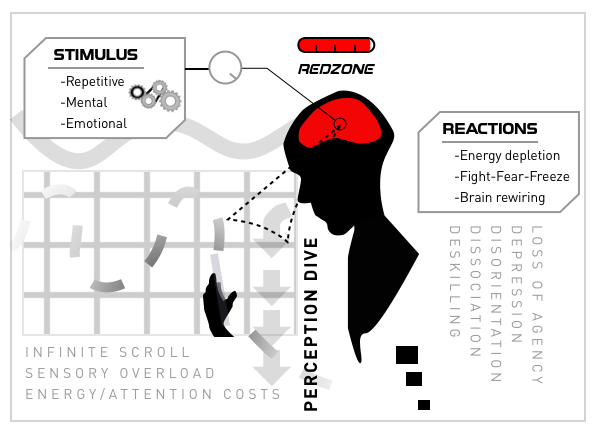
In gambling, there's a term called the dark flow, where the gambler is in the negative but still hitting the slots, stuck in a vicious pattern. In UX design, there's a term called dark patterns, where the user is purposely misguided into some wicked system. In my book, I stay with the frame I built: the individual tracking their own Redzone to stay out of that design outcome.
Most of the books and documentaries about social media "being bad" circle the same set of outcomes: online polarization, body dysmorphia, suicidal ideation, and certain types of content. That's the whole premise of a documentary like The Social Dilemma. Also those are the harm points being brought up in these big cases as well. It's where the public conversation has been stuck for about a decade.
The chart sits above that level. It exposes the design itself leaving the outcomes as predictable phases. It maps the thing all of those arguments grow out of. It shows the emergent pattern, the structure that produces those effects in different combinations for different people. When you look at it that way, you can see how those harms ride on top of deeper, repeatable mechanics. That's a framework. And a framework is what you need when the other side is armed with one word.
In order to give users a counter-design out of it we need new words, and we need the right words. As a designer myself auditing this harm-design, it's why I first shortened social media to SoMed. It nods to Aldous Huxley and Soma, sure, but it also takes something we've been calling by two soft words for twenty years. It turns it into something short, easy to handle, and medical. SoMed. And here are tools to use SoMed for your desired outcome.
So, when they say "problematic social media use," look at this chart as a tool. The terminology these companies rely on crumbles under scrutiny. It describes a defective product whose use over time causes injury. SoMed911 (Kaan, 2025) maps the full scope: 40 interconnected effects across five design-triggered elements that once understood, takes the problem out of problematic.
Want to learn more about the system?

Prefer Amazon? Order there instead →