
By Geo Kaan
Can’t pull away from your screen? Welcome to the club. Your dependence on social media is a lot like the way plants are drawn to light—a guidance beacon for growth. But it's more complicated. Moths are drawn to light through positive phototaxis; they evolved to steer by moonlight and get confused by the closer glow. In many ways, your dependence on social media combines these two phenomena: part guided lean like a plant, part reflexive pull like a moth. You still possess self-determination.
But the power social media can override your self-determination. Its influences are capable of conditioning your impulses at the deepest level. This isn't just about how smart you are or just falling for a flash of light; it's a complex psychological paralysis that affects even the most aware person.
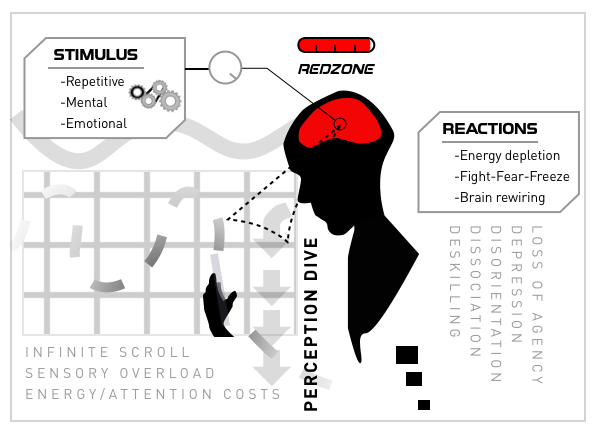
Social media companies use algorithmic tactics to hook core impulses into a state of object-dependency. The repetition of actions on social media feeds into your needs for autonomy, validation, and a sense of competence. This creates a cycle of energy depletion and induces stress into your brain circuits. You become sucked in a vicious flow pattern that not only causes inflammation but also amplifies your vulnerability to its effects further.
The result? You enter what I call the Redzone in the book, a place where you lose control over your thoughts, emotions, and sense of time. It's like living in a constant fight-or-flight state, entirely reliant on your devices. This is the "power of asymmetry" in the world of social media ethics—an invisible push that favors the platform over your nervous system.
Understanding Vulnerability: A Mathematical Perspective
Redzoning isn't just a momentary lapse in self-control; it's a complex psychological condition that leads to a long list of detrimental effects, from goal disorientation to impulse control issues. To comprehend your vulnerability to problematic use, consider this equation:
Here, ΔV represents your change in vulnerability to problematic social media use—the Redzone. It's a function of the current tech stimulus (S(λ)) minus the accumulated past interactions or exposures (ΣV). If the current stimulus is significantly stronger than your past accumulated stimuli, your vulnerability increases, pushing you closer to the Redzone. Conversely, if past accumulated stimuli are more dominant, it might suggest you've built resilience or tolerance.
Think of it this way: When the current stimulus on social media feels heavier than before, your vulnerability increases. This makes it harder to resist the pull of the Redzone. In the book, this factor is called the density of a feed with the cure being a special neutralizing sequence. If you've been exposed to a wide range of stimuli in the past and apply the neutralizing density process you'll be better equipped to resist the urge.
Putting It into Context
Let's apply this concept to a common scenario. Consider the effect of negative news or emotionally charged content. Each interaction with such content adds to your current tech stimulus (S(λ)). If this stimulus is considerably stronger than the sum of your past exposures (ΣV), you're more likely to fall into the Redzone.
Imagine scrolling through your feed, encountering a barrage of negative news articles and emotionally charged posts. Each click, like, or comment intensifies the current stimulus. If your previous interactions on social media have been primarily positive or neutral, this sudden influx of negative content can significantly increase your vulnerability. It becomes challenging to break free from the Redzone's 5 effects (self-neglect, goal disoriention and others).
Your dependence on social media is a natural consequence of the repetitive motions you engage in. When you repeatedly use specific parts of your brain and body in certain ways, something has to give. You end up making low-frequency decisions on social media, such as liking, validating, judging, commenting, and scrolling, at the expense of real-life high-frequency decisions.
As you spiral deeper into the Redzone, your attention is rendered useless. You find yourself unable to pull away from the screen, your self-determination completely hijacked, and trapped in a cycle of self-neglect. The invisible forces behind the screen act as permanent parasites to your core needs for autonomy, relatedness, and competence, pulling you further down the rabbit-hole.
Being in the Redzone feels like a high-energy rocket ride, mixing anxiety with moments of bliss. Every interaction on social media depletes your mental energy and accesses your memory banks. You traverse through your timeline, drawing on associations from childhood, memories of the past, and desires for the future. This continuous back-and-forth habituates how your memory and emotions flow, influencing not just you but society as a whole.
Yet, this high-energy state eventually leads to complete exhaustion and confusion. You're left with a residue called "attention residue." Even when you're offline, it still lingers within you.
Think of this state as an engine's flywheel. It's a psychological parasite, a barnacle-like system that extracts attention and depletes energy. Many individuals trapped in the red zone carry these continual psychological flywheels, which can clog your mental gears.
The race to the Redzone ends in exhaustion and confusion. You're left with fragments of what you saw or how you interacted with the platform, but little else. Without guidance on how to detect persuasive social media tactics and invisible forces, you default to their design. That's why I built the SoMed911 system: to redirect that ΔV toward your goals and restore your direction of choice online. Analog tactics for your digital vulnerability risk.

Download the FIRST CHAPTER FREE 👇
Then tell me: Is your social media usage causing stress?